Wednesday, September 23, 2026

Animal Farm: The Rest of the Story -- Epilogue


Animal Farm: The Rest of the Story -- Epilogue -- The Great Orange Pig in Hell


And it shortly came to pass…


The snarling demon cracked his whip and


The Great Orange Pig In Hell
Doodle by Forrest


shouted, “Go on – You’re here for eternity – Go on.”

“But everything is on fire!” cried the Great

Orange Pig. “Flames everywhere.”

“That’s why they call it hell,” grinned the slobbering

ghoul.

“Who are all those mournful souls flittering

just above the smoke and flames?” asked the Great

Orange Pig.

“They are all the suckers and losers who followed

you here,” snapped the fiend.

All my beautiful MAGGOTs? thought the Great

Orange Pig.


The demon pointed to a mob of raging spirits

flying destructively in all directions. The Great

Orange Pig looked confused. Who are they? Why are

they here? he wondered.

The ghoul interrupted his thoughts, “That is

the rounder of swine who you incited to turn the

Sacred Barn into a pigsty. Remember, you later pardoned

them.”


They struggled through a chaotic and terrifying

landscape. The Great Orange Pig pointed toward a

creature with two gruesome mouths, each blabbering

out of opposite sides of his face.

“Who is that ugly soul?” asked the Great Orange

Pig.

The demon replied, “That’s your VP, the

Hillbilly Piggy.”


They trudged on and a specter doing push-ups

in the molten muck became clear. It was surrounded

by shelled destroyed buildings and rotting corpses.

“Who is that disgusting being?” asked the Great

Orange Pig.

“Your Secretary of Wars of Choice, Piggy Pete,”

replied the demon.


Then they came upon a group of phantoms

floating in the smoke above the flames being swept

this way and that way by the raging winds.

“Who are they?” asked the Great Orange Pig.

“That is MAGGOT Mike’ the Squeaker of the

House and all the pigs that had turned into sheep,”

informed the beast.


Suddenly, there was a large group of lecherous

pedophile ghosts marching by and carrying an

angry-looking sow on their shoulders. The Great

Orange Pig pointed and said, “What?” The demon

just laughed and explained, “That is Ham Bondage,

your Attorney General.”


They walked on, choking on putrid fumes.

The Great Orange Pig pointed to another sow with

long flaming hair. She was surrounded by dead puppies

and frightened brown spirits. “WHO?” cried

the Great Orange Pig. “Surely you recognize Kristi

No-Room, your Homeland Security Director,”

asserted the ghoul.


They climbed a steep incline and approached

a gigantic smoldering boulder. It was bald on top.

Its most prominent feature was a gaping horrific

mouth engorged with brown bodies. Steam and

putrid water puddled at its base. The Great Orange

Pig gazed and gaped in terror. “What is this atrocity?”

he gasped. The ghoul shrugged his shoulders,

“Stephen Swine, your Border Security Nazi” he said.

“ICE melts down here!”


The demon looked up. He smiled at the threatened

spirit dominating the landscape. It dangled

threads of flame down towards the Great Orange

Pig.

“Who is this? – What does he want?” gasped the

Great Orange Pig.

“That is the Nasty Old Russian Bear,” said the

demon. “He just wants you to give him here what

you gave in life – your obedience!” the ghoul laughed.


They encountered a hoard of spirits, raging in

decreasing concentric circles above them. The Great

Orange Pig pointed up, “Who are they?”

The ogre shrugged his shoulders and laughed,

“They are the useless jackasses and jennies who ran

around in circles braying at one another while you

were destroying the Farm.”


Almost immediately, the Great Orange Pig

noted black-robed phantoms staring down on him.

He enquired of the demon, “Why do they look so

anguished?”

“They granted you immunity for your evil

deeds,” asserted the beast.

The Great Orange Pig was suddenly surrounded

by bent-over souls, struggling to drag an unmovable

obstruction from the sulfur, smoke, and flames.

“Who are these miserable spirits?” the Great Orange

Pig queried.

“This is your family, bearing the burdens of all

the evil that you have done throughout your life,”

grunted the beast.


After trudging for what seemed like eternity

through endless fire and brimstone, the Great Orange

Pig dropped to his knees, staring off in the distance.

His eye was caught by a glow, almost imperceptible

 from his vantage point. “What is that beautiful

vision?” he said pointing to the point of light.

The demon looked into the eyes of the Great

Orange Pig. 

He said softly, “The road to hell – it is

paved in gold.”


Sunday, January 14, 2024

Reflections From The Frog Pond

 As long as I live I won't forget 

when I first saw it
Just a kid of 8 or 10 
I was seldom indoors
No my natural habitat 
was the woods and creek beds
that edged our little town
extended by intermittent visits 
to the nature section 
of the school library

My niche included the rabbits 
blue jays monarch butterflies 
giant tree fungi fossils and minnows 
that I stalked each day 
and read about every evening
Then I found the frog pond
It was nothing of note
just an old muddy pool 
on an abandoned farm
where cows had likely 
drunk in better times

I was attracted by the growing ends 
of cat tails emerging from 
drying and shredded leaves 
at the interface of ground and cloudy water
It was about one foot from this edge
that I saw the jelly-like mass
that would frame my entire life
There gently undulating 
just beneath the pond's surface
warmed by mid-spring sunlight
was a clutch of frog eggs

I returned to the pond each afternoon 
on my walk home from school
alone so as not to expose my precious discovery
to the clods I otherwise considered friends
They would not understand
They would stomp splash 
destroy laugh and leave
Alone I observed for the first time 
that incredible first phase 
of every life
embryonic development

I brought the old magnifying glass 
that my grandmother who was nearly blind
used to see the Sunday funny papers
Through that bulging eye I watched amazed 
as the randomly assorted eggs
white on one side black on the other 
rotated to position all of their black halves
upwards capturing the sun's warmth
Over the next several weeks 
I watched them divide
and grow into spheres 
elongate into rippling crescents 
and hatch into swimming tadpoles
Each evening I read about 
amphibian embryonic development 
and natural history in the growing collection 
of overdue library books 
that accumulated in my small bedroom

This nascent understanding of 
the connection of things living now
and things that will live in the future 
was the point of departure 
for my entire life's passion and journey 
On subsequent visits to the pond
I watched the tadpoles transform into frogs 
resorbing their tails to grow legs
I began to note new relationships
connecting the embryo/tadpole/frog 
and its pond environment 
My evening reading shifted to books 
on conservation and the environment

Looking back this first glimpse of 
one of today’s most vexing problems
came from extending 
my young boy's glance 
of frog embryos and their environment
I began to perceive mammalian embryos
including human embryos
in their environments
I began to perceive the interrelation between 
the emerging individuality 
of a developing human fetus and 
the individuality of a pregnant woman
I began to understand 
a dramatic tension between 
interdependence and autonomy 
of fetus and mother

I began to recognize 
the incredible responsibility that 
even this glimpse of the human reproduction 
had placed on me
It wasn't until I was a teenager 
that I heard about contraception
It wasn't until I was in college
that I learned about abortion
It wasn't until graduate school 
that I became aware of population issues
I worked most of my life
in the turbulent vortex of 
women's health population and environment

And even these controversial issues 
have always felt like sub-plots 
to that main mystery of 
emerging fetal and maternal life 
that runs through my mind 
whenever the noise reduces to a level that 
I can hear myself think
And when I can hear myself think 
this is what emerges 
People who have an abiding belief 
in the sanctity of life people 
who share fundamental beliefs 
in the rights of women people
concerned about population growth and people 
who care about our planet's future
all have a great deal in common
Yes there are dynamic tensions 
at the intersections of these issues 
But there is common ground

I return to that frog pond of my boyhood 
often in my mind
especially when the din of conflict 
rings loudest in my ears
And there with the sun's low glint 
on muddy water
with iris shafts slowly bending 
to gentle surface ripples
with the trill of tree frogs 
or chirps of leopard frogs
or croaks of bull frogs

I see this common ground with precise clarity.
And it occurs to me that each of us 
must have such places
deep springs where fundamental values
and universal interconnections 
flow free and clear
And it seems to me that in these times 
when harsh diatribe 
is screamed from the furthest poles
it is essential for each of us 
to find our own frog ponds 
hidden somewhere in memory
And, visit there often.


Thursday, August 11, 2022

Frogue Magazine's Best of 2022


Fine Art Froguery


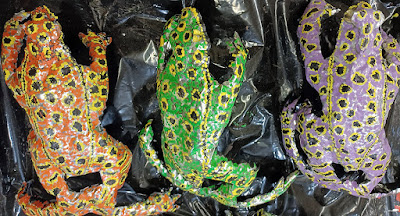
Frogue Magazine has named its Best Dressed Amphibians of 2022 These resplendent critters will make their debut in September at the North Carolina Botanical Garden at the Sculpture in the Garden show. .In this post, I will show how I make my Frogues from galvanized steel flashing sheets. First, I make a paper template of the frogue shape and mark it in the flat metal sheet.


The metal shapes are cut out with chicken boning scissors.


Using chasing and repose techniques, the flat shape is made into a 3D form.


I cut a piece if wood to fit inside the frogue belly.


The wood piece is epoxy glued into the belly. 


Glass eyeballs are glueed in the head and a metal top of head is added.


The bottom of the frogue is painted with black exterior house paint.


The top surface of the frog is painted using a pointillism technique. this allows the shiny metal to show, giving a sense of light and movement.


In this series, I have used primary, secondary colors and black and white exterior house paint.


Come to the Botanical Garden and select your favorite Frogue.

 Forrest

Saturday, July 30, 2022

Food For Sex

 The Naughty Little Secret of Pollination

Pollination is a complex mutual process that has evolved to insure the survival of animal and plant species. The pollinator species seeking food transfers gametes of the plant species producing offspring. The pollinator receives nutrition while the plant increases genetic diversity in the population


The prototype for this series was a Trillium and a generic bee.


This hanging sculpture, created in galvanized steel and decorated with exterior house paint, now lives with Becky in Chapel Hill, NC.


These sculptures are made from galvanized roof flashing cut out with Joyce Chen chicken boning scissors. They are shaped by chasing and repose techniques. Details are painted in exterior house paint using pointillism to produce a light and motion effect. The series will be on exhibit at the NC Botanical Garden starting in September.

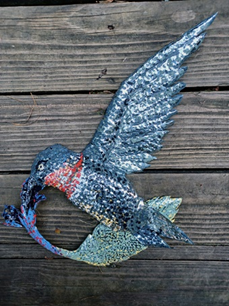
Blue Salvia and Ruby Throated Hummingbird


Hummingbirds drink up to two times their body weight per day. As they move from plant to plant, they carry pollen. They pollinate the native wildflowers and decorative cultivars. Hummingbirds are only found in the western hemisphere.

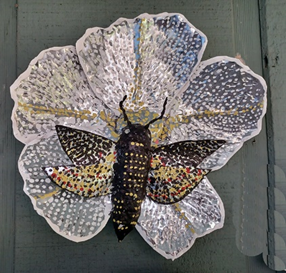
Moonflower and Hawkmoth


The hawk moth drinks nectar from sweet-smelling flowers, many of which bloom at night. Most hawk moth species have a long proboscis. This hollow, tongue-like appendage is used to access nectar deep inside flowers. Pollen sticks to the moth’s face, proboscis, and legs when it feeds. It then transports the pollen to successive flowers.

Bee Balm and Hummingbird Moth


Hummingbird moths share many common characteristics with hummingbirds. Both of these creatures are effective pollinators of many of the same flowers, and hummingbird moths also sip nectar from many of the same blooms that hummingbirds prefer. 

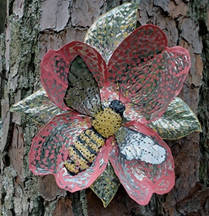
Dogwood and Honeybee


Honeybees, which came from Europe to North America with colonists, are social insects and live together in nests or hives. Honeybees are remarkable for the “dancing” movements they perform in the hive to communicate information to their fellow bees about the location of a particular food source in the surrounding area. Honeybees are America’s primary commercial pollinator. Plants include almonds, non-citrus fruit and decorative trees, berries, melons, and squash.

Daisy and Bumble Bee


Big fuzzy bumblebees pollinate flowers through a method called “buzz pollination,” a rapid vibrating motion which releases large amounts of pollen onto the bee. In most situations, “buzz pollination” will allow a bumblebee to pollinate a flower in a single visit. They are important pollinators of wild flowering plants and crops. As generalist foragers, they do not depend on any one flower type. However, some plants do rely on bumble bees to achieve pollination.

Vinca and Blue Orchard Bee


The blue orchard bee is a native solitary mason bee in the United States and Canada. It is of great interest for use as a native pollinator of fruit trees and blueberries. Blue Orchard Bees emerge early in the spring and therefore pollinate early flowering species.

Squash and Mason Bee


Another solitary native bee, Mason bees are efficient pollinators of native plants such as pumpkins, beans and squash.

Sunflower and Monarch Butterfly


Monarchs are not the most efficient pollinators, they can and do pollinate some plants. Monarchs are considered a flagship species or a poster species for all pollinators.  Goldenrod, Butterfly Bush, Cosmos, Lantana, Lilac, and Zinnia are some plants that attract Monarchs.

Hibiscus and Tiger Swallowtail Butterfly


Among the nectar plants of the tiger swallowtail are butterfly bush, cone flower, milkweed, phlox, lilac, ironweed, and wild cherry. 

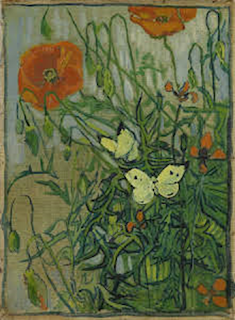
Poppy and Sulphur Butterfly


Vincent


This pollinator pairing is inspired by one of my favorite Van Gogh paintings. I saw it on one of my visits to his museum in Amsterdam.

 English Daisy and Azure Blue Butterfly


The Azure Blue is found in North America and Great Britain. It is found in a variety of grassy habitats. The brightly colored males are conspicuous, but females are more secretive.

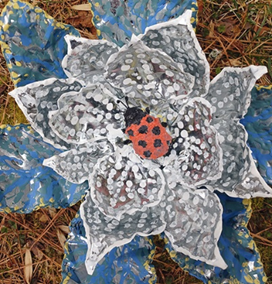
Magnolia and Lady Bug Beetle


 Magnolias among the oldest of the flowering plants, evolving earlier than many common pollinators such as bees, butterflies. They accordingly developed flowers for pollination by beetles and flies, which were the primary insect pollinators 100 million years ago.

Sculpture in the Garden 2022  
North Carolina Botanical Garden -- September to December
Food for Sex -- The Naughty Little Secret of Pollination -- Forrest C. Greenslade, PhD

The accompanying notes are paraphrased from a variety of online sources without reference. I intend them only to give perspective to my thinking in creating the works.

Forrest