Friday, October 5, 2012

Fairies and Gnomes


Here are pics from a Fairy and Gnome workshop for kids that I did at the North Carolina Botanical Garden in collaboration with Kidzu Children’s Museum. The photos were taken by Stephanie from Kidz.
 
My Fairy God Grandmother example for the kids

Hope you enjoy the cute kids,

Forrest

Friday, September 14, 2012

Quilter Patterns a Colorful Life in her Chatham Home


Visitors to the 20th Chatham Studio Tour will enjoy Quartz Hill Quilts (http://www.quartzhillquilts.com), the sewing studio of Susanna Stewart, in a home that she and her husband Sandy built with their own hands over a period of over 35 years. “It is the home in which I grew up - not in the traditional meaning of the word, but where I learned to be an adult in a world full of challenges,” Stewart says. “Life here began in a tree house, then a house slowly evolved, grew, aged, got repaired and remodeled, ever changing, a reflection of my own process and growth.”

Stewart creates quilts alive with color and dazzling floral fabrics. “Currently I find myself drawn mostly to bed quilts or throws,” she notes. “I have hundreds of quilting projects in my head. Sometimes I have three going at one time. I am fortunate enough to have adequate space and light, so I can spread out.” Lately she has been drawn to wall hangings and totes.

Stewart’s life path to fabric art and the Chatham Artists Guild was long and circuitous. Susanna’s mother died when she was eight year old. “I have very few memories of my mom,” she stresses, “but her loss was an issue for me for many years.” When her father remarried a year after her mother’s death, her relationship with her stepmother was difficult. “There was a lot of turmoil,” Stewart recalls. “So much so, that for my last two years of high school I went off to Concord Academy, a boarding school in Massachusetts.” It was there that she had an intellectual awakening. “I discovered Gandhi, Faulkner, and was particularly enthralled by an art history course,” she says. During summers, she worked on a ranch in Montana to avoid the difficulties at home. “I loved it there,” she asserts. “I cooked, build fences, trained horses.”

“In a lot of ways, the early death of my mother and the challenging relationship with my stepmother resulted in many of my personal strengths,” Stewart concludes.  “The greatest gift my stepmother provided was to teach me to sew.”

On graduation from high school in 1961, her father urged her to go to nursing school. “Back then, girls became either nurses or teachers,” she says. She started at Boston University and completed studies at Rex Hospital in Raleigh.

For 20 years Stewart worked as a nurse, mostly at Duke and UNC. Then, she made a major life change. “I found the schedule to be difficult on family life, and as a self employed carpenter and stone mason I had much more say about my schedule,” she asserts. Building our own home necessitated developing skills in this area, and we branched out building homes for others.” During this time I took a class in stained glass and made many windows, mostly with floral designs. Years later I discovered I had high levels of lead in my blood, so that was the end of stained glass work.

By the time Stewart was in her late 30s, she became interested in acupuncture. “I was still drawn to the healing arts,” she says. “I realized I did not want to be hauling heavy boards around when I was 50” The family moved to Santa Fe for three years, while she studied acupuncture. For 20 years, what is now Stewart’s sewing home studio, was an acupuncture clinic. “I have been “retired” from that practice for several years now, and quilting has taken up what spare time I manage to carve out for myself,” she quips. The arrival of grandchildren, including twin granddaughters eighteen months ago has limited her time for quilting. Stewart’s daughter is Lara O’Keefe, a well regarded Chatham County potter.

Since childhood, Stewart had a passion for the bright prints and colors in fabric, and she had quite a stash of fabric even before she made her first real quilt about 11 years ago. “I was in the local fabric store, Thimble Pleasures, when I fell in love with a quilt hanging on the wall in the shop. “I took a class and off I went,” she exclaims. “I am very grateful to Julie Holbrook for creating such a nourishing, stimulating fabric shop just 25 minutes from my house.” I have taken many classes there, although my learning continues just by being in the shop.

 As Stewart’s grandkids grow, and she has more time to quilt, she employs the many strategic and organizational skills that she has learned over her varied and colorful life.

“Quilting is much like carpentry and stained glass work, but a lot easier on the body” she laughs.

Susanna Stewart is one of the many regionally and nationally recognized artists and fine crafts people who will open their studios the first two weekends in December at the 20th Annual Chatham Studio Tour (http://www.chathamartistsguild.org/about/details.html). Visitors from all around enjoy Chatham’s rural beauty and share with the members of the Chatham Artists Guild in the creative process. It is a holiday tradition, and an opportunity to purchase unique original art.

Saturday, September 1, 2012

Art in the Village -- Autumn 2012


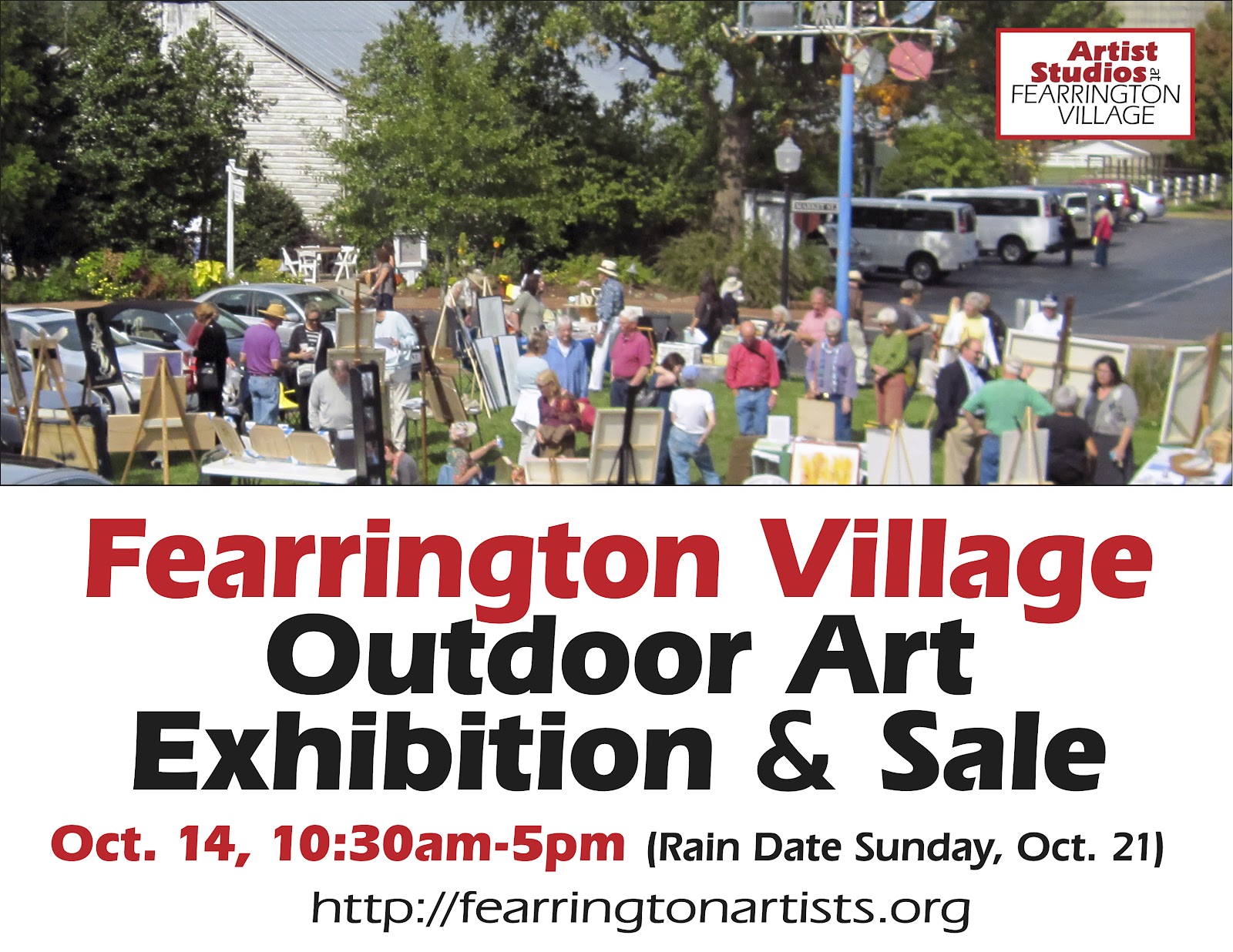
Artist Studios at Fearrington Village presents the 3rd Art in the Village. Browse fine art and crafts among the beautiful gardens of Fearrington Village. The outdoor exhibit and sale showcases a group of over 30 visual artists who live and create within Fearrington. Exhibitors:  painters, potters, sculptors, photographers, jewelers, woodworkers, fabric artists - art which represents a wide variety of styles and media. Join us – it’s family friendly and free!

 Stroll through beautiful gardens. Enjoy lovely and exciting music. Have a snack or a meal in Fearrington’s renowned restaurants. Visit McIntyre’s Books, a delightful independent bookstore.

Enjoy exhibits by local, regional and nationally-known artists who live and create in Fearrington Village and purchase their original artworks.

Some of the artists participating:
Sandy Beach – fused glass and glass creations
VidaBeth Bensen – hand-pulled screen printing
Evelyn Brown -- pottery
Beverly Crow – painting and mixed media
Carolyn Davenport – collage and mixed media
Forrest Greenslade – painting and sculpture
Murry Handler -- contemporary acrylic painting, bold ink-brush prints
Karen Havighurst – collage and mixed media

Nancy Jacobs -- painting
Florence Johnson – watercolor painting
Helen Kotsher – painting in oils and pastels
Matthew Leavitt -- photography
Roni Liberman – wooden furniture and turned bowls
Roy Lindholm -- photography
John Makowski -- ceramics
Marcelle Pachnowski – nonobjective colorist painting
Jane Palkoski -- fabric art and jewelry
Zen Palkoski -- sculpture
Leslie Palmer – painting and mixed media
Stan Pomeranz-- pottery
Deborah Sanks --painting
Betty Schabacker -- mixed media, collage 
Ruta Schuller – botanical paintings and mixed media
Rita Spina – junque (found object) art
Pat Stewart -- basketry
El Temblay – watercolor painting
Harry Lane Wurster -- mixed media


 Artist Studios at Fearrington Village
http://fearringtonartists.org


Friday, August 31, 2012

Chatham Photographer Exhibits Unexpected Visions


Len Jacobs will display his life’s collection of nature and travel photographs at his home studio during the 20th Chatham Studio Tour the first two weekends in December, but these visions are serendipitous.

Chatham County photographer Len Jacobs
When Len Jacobs was a young child in the 1920s in the Harlem district of New York City, it was evident that he had some sort of vision problem. “My parents had a small shop there, which went belly up, and we had to move to Brownsville Brooklyn to my mom’s family home,” Jacobs remembers. “They had a two-family house, with a store underneath.” In the store, his grandfather  made ladies coats and gave Len’s dad a job. “His dad had to learn how to use a sewing machine, and to design clothing,” Jacobs' recalls. His vision problems increased, and when he was three years old, Len’s folks finally found an optometrist in Hackensack New Jersey, where they learned he had only 7% vision. The problem was spreading to the extent that "I might even go blind,” Jacobs stresses. “I probably couldn’t even go to school,”

Fortunately, there was a Sight Conservation Class available in the New York City Public Schools.  “It was K through 6th grade, and the teacher understood kids with visual problems as well as their needs” Jacobs says. “We had special pencils, large print books, matte paper while  physical activity was prohibited.” It was thought that Jacobs’ visual problems made him susceptible for a possible retinal detachment.

In Junior high school there was also a Sight Conservation Class an hour’s double trolley ride away. Despite the school’s prohibition against physical exertion, Len and his visually impaired classmates played punchball, a street game combining the elements of handball, stickball and baseball, at lunch hour. In high school, he became even more physically active. “I had no problems with my eyes, and even began thinking of becoming a Physical  Education teacher, he notes.

Jacobs pursued this goal at NYU School of Education, received a BS in Education in 1948, and an MA in Health Education and Administration a year later. However, when he started looking for a job in the New York City public school system, his old vision problems came to the fore again. “You had to have 20/30 eye sight to get a license to teach Phys Ed,” Jacobs laments, “therefore I failed the medical exam.”

The diagnosis was a type of astigmatism creating an elongation of the eyeball,  which might make him a candidate for a retinal detachment.  Jacobs filed a series of appeals with the school system and the New York State Commissioner of Education. He had examinations by prominent ophthalmologists, who documented that the previous diagnosis was in error. He waited for the authorities to respond. In the mean time he and his wife Doris relocated to Elmira, NY and Washington, DC, where he found various jobs. Finally, in 1951 Len Jacobs received licenses to teach high school biology, high school physical education and elementary school in New York City. Finding an actual job was still a challenge, but he landed a position as an Attendance Officer where enjoyed a 35 year career while he became a Certified Social Worker. After a competitive exam, he became licensed and was appointed as a District Supervisor of Attendance in the New York City School system Bureau of Attendance. Of course he had many educational and societal interesting experiences. “One day, I had to visit John Gotti’s home to find out why his kid was absent from school,” he quips.

Jasper National Park; Alberta, Canada
Photo by len Jacobs
Jacobs' family life, with four children, was the foundation for his avocation as a photographer. In the summer, we had more time than money,” he laughs. “We started taking little camping trips for family fun.” He, of course, took vacation photos. “I wasn’t a very good photographer,” he admits, “so I began to take courses and to study books on photography while riding the Long Island Railroad each day to work.” He joined local camera clubs to hone his skills. He began to share his photos, taken from larger and larger trips to state and national parks all across the country and in Canada, with audiences throughout the greater New York City area. He has won numerous awards and recognition. The one he is most proud of ,however, was his "Ice Pattern" at the New York Metropolitan Museum of Art,  Photography as an Art Form.

Now in retirement here in North Carolina, Len Jacobs continues to share his life’s catalog of photographic experiences. He has served as President of the Nassau County Camera Club on Long Island as well as President of Chapel Hill Camera Club. In the past he was Director of the Southeastern Council of Camera Clubs Convention. He has presented multiple projector slide shows with music and poetry and special audio-visual techniques. He still judges photo competitions and lectures on "photo composition." He recently began to transfer the images captured in his myriad of slides to digital files, and printing them for people to enjoy in their own homes. “I really enjoy it when people share my precious visions,” Jacobs emotes.

On the inside jacket flap of his book "Birds I've Seen" the following is written, "There is something inherently special about Len's photography. These photos illustrate that photography performed with such care and precision, with such love and respect, with such skill in the use of camera tools, can be an art form for all to share and enjoy."

The irony of it all is, that a man who was told to avoid physical activity, and that at the age of three might soon be blind, has used his camera to record and share with others some of the visual music of our beautiful world. 

Len Jacobs is one of the many regionally and nationally recognized artists and fine crafts people who will open their studios the first two weekends in December at the 20th Annual Chatham Studio Tour ( http://www.chathamartistsguild.org/about/details.html ). Visitors from all around enjoy Chatham’s rural beauty and share with the members of the Chatham Artists Guild in the creative process. It is a holiday tradition, and an opportunity to purchase unique original art.


Tuesday, August 14, 2012

Doin' A Dragon

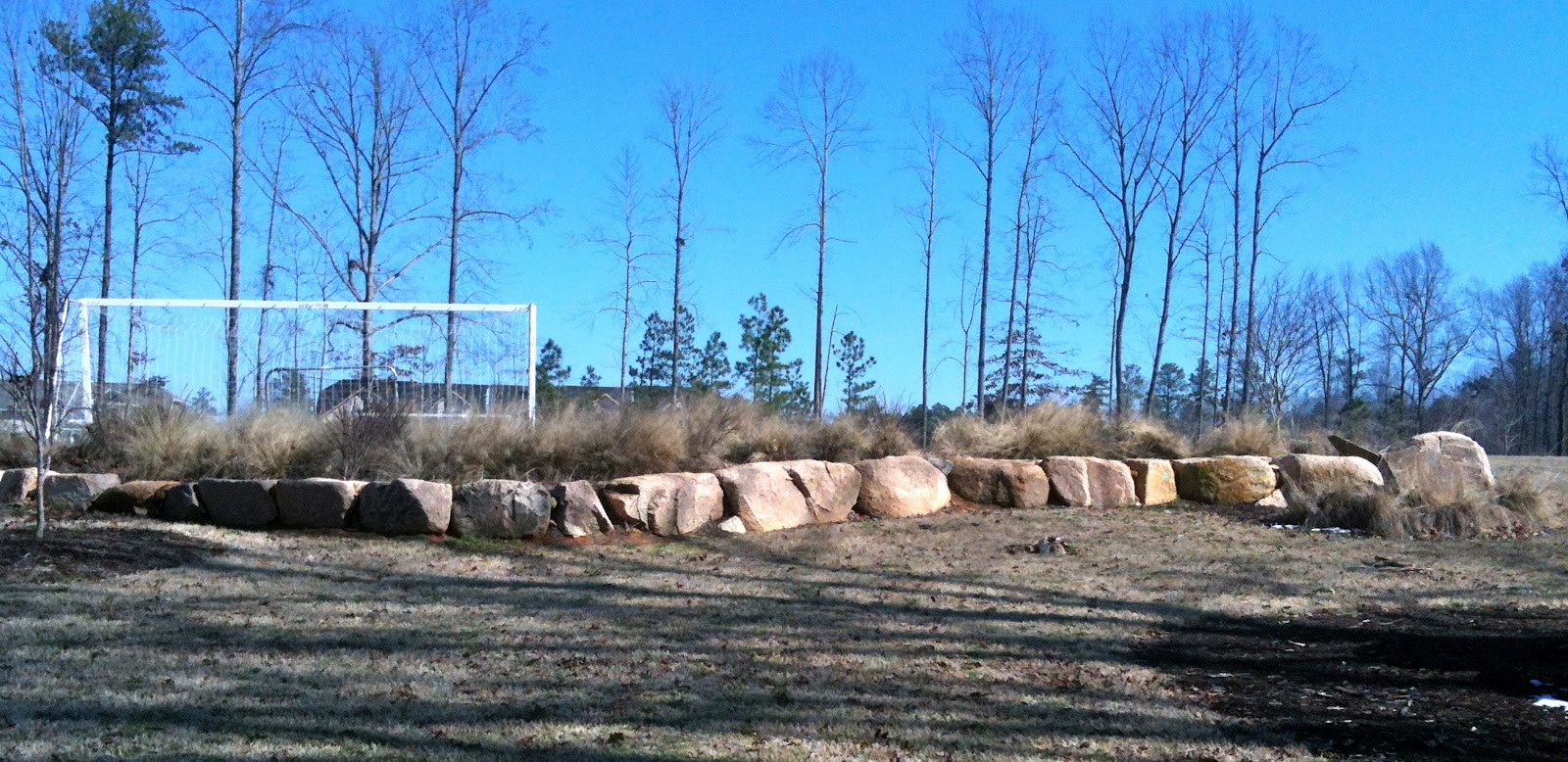
Chatham County North Carolina's Pittsboro has some wonderful parks and recreation facilities. The Mary Hayes Barber Park, just north of town off Route 15/501, is a delightful spot for sports and kid's play.
Parks planner Paul Horne, when laying out the park, brought in an assemblage of large rocks. He had them laid out in a serpentine arrangement, as a containing wall for a garden just behing the soccer field. In his mind's eye, Horne saw a giant dragon frolicking among the grasses and flowers.


Horne inspired Chatham artists Jonathan Davis, Joe Kenlan and Forrest Greenslade to transform the formidable wall of rocks into an imposing dragon for kids to enjoy.

Sculptor and painter Greenslade first measured the "head stone" and welded a base for the armiture, the skeletal structure that underpinns a sculpture.


Stone mason Joe Kenlan drilled holes into the large very hard rock, and fastened the "lower jaw" to the rock with bolts.


Greenslade then began creating the armature from hardware cloth and chicken wire. He incorporated a red tongue that he had fabricated from sheet steel.


Horne, Kenlan and Greenslade then mixed a composite material from cement, peat moss and an acrylic fortifyer. His procedures are published on his website.They plastered it over the the wire armiture. Horne added spines, using slate tiles rescued from on old building.


They inserted class eyeballs that had been created by glass artist Jonathan Davis.


And voila -- Pittsboro's ferocious but friendly dragon.


Greenslade says, "it's more fun than any old guy deserves".

Friday, August 10, 2012

Chatham writer debuts new book at McIntyre's

Local writer John Keith will read from his latest book, "Canebrake Beach" at McIntyre's Bookstore in Fearrington Village on Friday, August 24 at 2:00 p.m. 

"Canebrake Beach" is a novella and short story collection that explores friendships, relationships, and conflicts of white and black Southerners at various intervals over a span of seventy years.  Four tenant families, some black and some white, lived on the farm owned by the author's family when he was a child.  Although no one who grew up on the farm was active in the civil rights movement except for him, in "Canebrake Beach" he imagines what might have happened to members of similar black and white families as they progressed from the Jim Crow era and beyond.


  .

John Matthew Keith is a retired Episcopal minister who has lived in Fearrington Village, North Carolina with his wife Rilla for over five years.  He began writing fiction as a student at Duke University where he was awarded the Anne Flexner Memorial Prize (presented by William Styron).  Anne Tyler was a student in the creative writing class taught by Dr. William Blackburn when John was the teaching assistant.  Although his secular stories, like "Canebrake Beach", have been published in magazines and periodicals over the years, his most recently published books focused on spirituality: "Complete Humanity in Jesus: A Theological Memoir" (2009) and "True Divinity in Christ: A Testimony of Faith and Hope with Four Short Stories" (2010).  

"Canebrake Beach" was published simultaneously as an e-book and in paper.

Thursday, August 2, 2012

Chatham Artist Revels in the Color and Fabric of an Eclectic Life


Fiber artist Christie Minchew (www.christieminchew.com) says, “I have the good fortune of living in an area that is rich with talented artists.” She now has added her own artistic vision and skills to those of members on the Chatham Artists Guild http://www.chathamartistsguild.org/), and will open her studio the first two weekends in December at the 20th Annual Chatham Studio Tour. Visitors to Minchew’s studio will enjoy her unique soft sculptural creations. “I thrive on creativity - mine and others', she notes. “For my own art, I tend to be drawn to media and objects that allow me to build with my hands.” Minchew currently is using wool and silk fiber, cloth, yarns, thread, wire, paper and other things in processes including wet-felting, dyeing, weaving, stitching, and anything else she can find useful.

Christie Minchew in her Chatham County Studio
Christie Minchew comes to her eclectic adaptability genetically. “I was a Navy brat, and moved a lot until I was nine,” she reflects. “My mom was frugal and creative”, she reminisces. “If she wanted something for the house or for us, she’d figure out how to make it herself.”  Christie joined in her mother’s projects, and developed skills for working with her hands at an early age. “I didn’t really ever play with dolls, she recalls. “I made rooms in which they could live in style.” Already drawn to color, Minchew brightly painted the inside of her closets. She constructed purses from cardboard, and her mother taught her to sew.

Later living in the DC area, her father stationed at the Pentagon, Christie enrolled in the School of Architecture at Virginia Tech. For an architecture statement project, she partially designed and constructed a weaver’s loom – It took her five years – It now lives in her Chatham studio.

She graduated with a specialization in Landscape Architecture, and for about a year and a half worked as a landscape architect in Richmond. In the 1980s, a downturn in the economy prompted a significant change in Christie’s life path. She talked herself into a job as a System Engineer at IBM, providing technical sales support. After several years, she moved to sales, capitalizing on her natural skills in relationship marketing of “big computers”. Her over 20 year career associated with IBM found her living in California, and finally in Raleigh. In 2001, she left the corporate life.

Fiber art inspired by microscopic photo of mahogany structure
framed in mahogany
She craved a less corporate personal look, and designed and hand made a purse. Friends encouraged her to make more. She started participating in craft shows. She recalls, “One day in a fabric store, the proprietor noticed one of my hand made purses and asked if I could make patterns.”  This launched a new business, “Sweetbriar Studio”, a sewing pattern business that continues today.

 Minchew’s latest transformation resulted from her desire to transition from fine craft to works more creatively artistic. “In about 2008, I wanted to start making table runners, but was looking for a way to make them not only decorative, but more free-form,” she states. “While on vacation, I was thumbing through a magazine and noticed an advertisement for a "wet-felted" garment. When I got home, I taught myself to wet-felt.” As a result of getting back into sewing and then working with felting, Christie’s latent addiction to all things fiber was reignited.

Sculptural fiber art inspired by galactic image
Minchew’s unique fabric creations are characterized by dimensionality, pattern and texture, and often inspired by the microscopic and telescopic patterns in the natural world. It is, as she puts it, “organicy looking”. “I like this counterpoint to the technical control of the corporate world, or even the pattern business.” The wet felting process is exciting to her. “The material transforms before your eyes,” she emotes. “There is this wonderful balance between artistic control and serendipity.”

Christie Minchew is one of the many regionally and nationally recognized artists and fine crafts people who will open their studios the first two weekends in December at the 20th Annual Chatham Studio Tour (http://www.chathamartistsguild.org/about/details.html). Visitors from all around enjoy Chatham’s rural beauty and share with the members of the Chatham Artists Guild in the creative process. It is a holiday tradition, and an opportunity to purchase unique original art.