Saturday, July 30, 2022

Food For Sex

 The Naughty Little Secret of Pollination

Pollination is a complex mutual process that has evolved to insure the survival of animal and plant species. The pollinator species seeking food transfers gametes of the plant species producing offspring. The pollinator receives nutrition while the plant increases genetic diversity in the population


The prototype for this series was a Trillium and a generic bee.


This hanging sculpture, created in galvanized steel and decorated with exterior house paint, now lives with Becky in Chapel Hill, NC.


These sculptures are made from galvanized roof flashing cut out with Joyce Chen chicken boning scissors. They are shaped by chasing and repose techniques. Details are painted in exterior house paint using pointillism to produce a light and motion effect. The series will be on exhibit at the NC Botanical Garden starting in September.

Blue Salvia and Ruby Throated Hummingbird
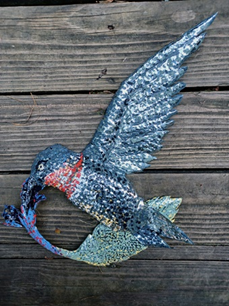


Hummingbirds drink up to two times their body weight per day. As they move from plant to plant, they carry pollen. They pollinate the native wildflowers and decorative cultivars. Hummingbirds are only found in the western hemisphere.

Moonflower and Hawkmoth
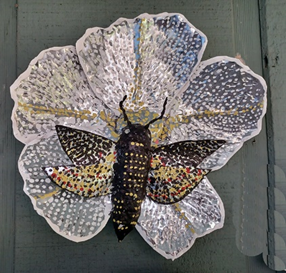


The hawk moth drinks nectar from sweet-smelling flowers, many of which bloom at night. Most hawk moth species have a long proboscis. This hollow, tongue-like appendage is used to access nectar deep inside flowers. Pollen sticks to the moth’s face, proboscis, and legs when it feeds. It then transports the pollen to successive flowers.

Bee Balm and Hummingbird Moth


Hummingbird moths share many common characteristics with hummingbirds. Both of these creatures are effective pollinators of many of the same flowers, and hummingbird moths also sip nectar from many of the same blooms that hummingbirds prefer. 

Dogwood and Honeybee
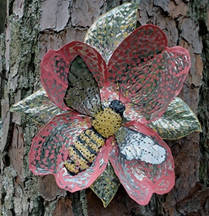


Honeybees, which came from Europe to North America with colonists, are social insects and live together in nests or hives. Honeybees are remarkable for the “dancing” movements they perform in the hive to communicate information to their fellow bees about the location of a particular food source in the surrounding area. Honeybees are America’s primary commercial pollinator. Plants include almonds, non-citrus fruit and decorative trees, berries, melons, and squash.

Daisy and Bumble Bee


Big fuzzy bumblebees pollinate flowers through a method called “buzz pollination,” a rapid vibrating motion which releases large amounts of pollen onto the bee. In most situations, “buzz pollination” will allow a bumblebee to pollinate a flower in a single visit. They are important pollinators of wild flowering plants and crops. As generalist foragers, they do not depend on any one flower type. However, some plants do rely on bumble bees to achieve pollination.

Vinca and Blue Orchard Bee


The blue orchard bee is a native solitary mason bee in the United States and Canada. It is of great interest for use as a native pollinator of fruit trees and blueberries. Blue Orchard Bees emerge early in the spring and therefore pollinate early flowering species.

Squash and Mason Bee


Another solitary native bee, Mason bees are efficient pollinators of native plants such as pumpkins, beans and squash.

Sunflower and Monarch Butterfly


Monarchs are not the most efficient pollinators, they can and do pollinate some plants. Monarchs are considered a flagship species or a poster species for all pollinators.  Goldenrod, Butterfly Bush, Cosmos, Lantana, Lilac, and Zinnia are some plants that attract Monarchs.

Hibiscus and Tiger Swallowtail Butterfly


Among the nectar plants of the tiger swallowtail are butterfly bush, cone flower, milkweed, phlox, lilac, ironweed, and wild cherry. 

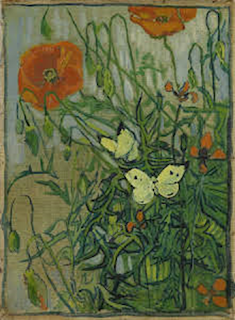
Poppy and Sulphur Butterfly


Vincent


This pollinator pairing is inspired by one of my favorite Van Gogh paintings. I saw it on one of my visits to his museum in Amsterdam.

 English Daisy and Azure Blue Butterfly


The Azure Blue is found in North America and Great Britain. It is found in a variety of grassy habitats. The brightly colored males are conspicuous, but females are more secretive.

Magnolia and Lady Bug Beetle
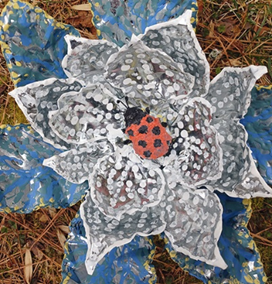


 Magnolias among the oldest of the flowering plants, evolving earlier than many common pollinators such as bees, butterflies. They accordingly developed flowers for pollination by beetles and flies, which were the primary insect pollinators 100 million years ago.

Sculpture in the Garden 2022  
North Carolina Botanical Garden -- September to December
Food for Sex -- The Naughty Little Secret of Pollination -- Forrest C. Greenslade, PhD

The accompanying notes are paraphrased from a variety of online sources without reference. I intend them only to give perspective to my thinking in creating the works.

Forrest

Tuesday, December 28, 2021

Reflections from the Frog Pond


Reflections from the Frog Pond
A prose poem


As long as I live
I won't forget 
when I first saw it
Just a kid of 8 or 10 

I was seldom indoors
No my natural habitat 
was the woods and creek beds
that edged our little town

A world extended
by intermittent visits 
to the nature section 
of the school library

My niche included rabbits 
blue jays monarch butterflies 
giant tree fungi fossils and minnows 
that I stalked and read about

Then, I found the frog pond
just an old muddy pool 
on an abandoned farm
where cows had drunk in better times

I was attracted by the growing ends 
of cat tails emerging from 
drying and shredded leaves 
at the interface of ground and cloudy water

It was about one foot
from this muddy edge
that I saw the jelly-like mass
that would frame my entire life

There gently undulating 
just beneath the pond's surface
warmed by mid-spring sunlight
was a clutch of frog eggs

I returned to the pond each afternoon 
on my walk home from school
alone so as not to expose my precious discovery
to the clods I otherwise considered friends

They would not understand
They would stomp
splash and destroy
laugh and leave

Alone I observed for the first time 
that incredible first phase 
of every life
embryonic development

I brought the old magnifying glass 
that my grandmother
who was nearly blind
used to see the Sunday funny papers

Through that bulging eye
I watched amazed 
as randomly assorted eggs
white on one side black on the other 

Rotated to position
all of their black halves
upwards
capturing the sun's warmth

Over the next several weeks I watched them divide and grow into spheres 
elongate into rippling crescents 
and hatch into swimming tadpoles

Each evening I read about 
amphibian embryonic development 
in the growing pile of overdue library books 
that accumulated in my small bedroom

This nascent glimpse of the connection between
things living now and in the future 
was the point of departure 
for my entire life's passion and journey 

On subsequent visits to the pond
I watched the tadpoles
transform into frogs 
resorbing their tails to grow legs

I began to note new relationships
complex interactions
connecting the embryo/tadpole/frog 
and its pond environment

Looking back, this first glimpse of 
one of today’s most vexing problems
came from my young boy's glance 
of frog embryos and their environment

I began to perceive
mammalian embryos
including human embryos
in their environments

I began to perceive the interrelation between 
the emerging individuality 
of a developing human fetus and 
the individuality of a pregnant woman

I began to understand 
a dramatic tension between 
interdependence and autonomy 
of fetus and mother

I began to recognize 
the incredible responsibility that 
even this glimpse of the human reproduction 
had placed on me

It wasn't until I was a teenager 
that I heard about contraception
It wasn't until I was in college
that I learned about abortion

I worked most of my life
in the turbulent vortex of 
women's health population
and environment

And even these controversial issues 
have always felt like sub-plots 
to that main mystery of 
emerging fetal and maternal life 

Sometimes, when the noise around me
reduces to a level that 
I can hear myself think
this is what emerges 

People who have an abiding belief 
in the sanctity of life people 
who share fundamental beliefs 
in the rights of women

People concerned about
population growth and who care about our planet's future
all have a great deal in common

Yes there are dynamic tensions 
at the intersections of these issues
important tensions 
But there is common ground

I return to that frog pond of my boyhood 
often in my mind
especially when the din of conflict 
rings loudest in my ears

And there with the sun's low glint 
on muddy water
with iris shafts slowly bending 
to gentle surface ripples

With the trill of tree frogs 
or chirps of leopard frogs
or croaks of bull frogs
I see this common ground

And it occurs to me that each of us 
must have such places
deep springs where fundamental values
flow free and clear

And it seems to me that in these times 
with harsh diatribe screaming from the poles
we must each find our own frog pond 
hidden somewhere in memory

And, visit there often.

Forrest C. Greenslade, PhD
Written sometime in the 1990s
Revisited December 2021

Thursday, June 3, 2021

Welcome to Dogwood Alley


My artist friend and neighbor Beverly Crow commissioned me to sculpt an arch over her new garden gate. She created a design inspired by Dogwood branches.


Bev and I chalked a scaled up layout on the concrete floor of my shop.


I used a cutting wheel on my angle grinder to cut several segments of rebar and we began to experiment with the shape of two branches arching together.


Using a Dogwood leaf photo as reference, I sketched leaf shapes on 16 gage cold rolled steel.


I cut the leaves out with a Cobra oxy/acetylene cutting torch 


To test the design concept. we prepared a small maquette blossom from scrap brass. 


Using a Dogwood blossom photo as a pattern. I cut flower petals out from copper
sheeting. 


Bev and I experimented with the design by moving the components around on the shop floor. 


I connected the rebar branch segments and steel leaves using an arc welder. 


I assembled the copper blossoms with JB epoxy glue. 


I welded short pieces of steel rod into stamen/pestle elements and attached them on the copper blossoms with epoxy. 


I fabricated assembly units at the base of each branch for insertion into the upright posts of Bev’s garden gate. 


Bev designed a device to couple the two branch units and I fabricated it in steel sheet and rod. 


We assembled the Dogwood branches and Bev used copper tubing to fashion a vine coiling around the branches. I made leaves for the vine and attached them to the assembled arch. 


Voila!


Hats off to collaboration


Sunday, November 8, 2020

Animal Farms -- The Rest of the Story -- Really


A short story in three parts by Forrest C Greenslade

Part One of Three 

Things went pretty well after the farmer was expelled. All of the animals worked together. They made rules to ensure the old ways did not come back to the farm. I guess you know what happened then. The pigs decided that “All animals were equal but some animals were more equal than others.” They took


up residence in the farmhouse, which was prohibited by the rules. They dominated the other animals and the farm became as bad as it was when the farmer was in charge – a precautionary tale.

But the story didn’t end there. The pigs began to argue among themselves. Some pigs banded together and formed a powerful group – The Great Outstanding Pigs. The GOP made the other pigs and all the other animals work long hours under intolerable conditions. They did not let any other animals have a say in the governance of the farm. They called it reform. The GOP bought up other farms. If the human farmers resisted, the pigs forced the other animals to invade the farm and take it over. The GOP became bigger and more powerful over the next few years.

Then, a different pig took over the GOP -- the Great Orange Pig. He had amassed farms all over the world and had written a book – The Art of the Squeal. He made all the pigs wear silly red hats with holes cut out for their little pointed ears. He gave all his little piglet offspring high positions in the management of all the farms. He associated himself and his administration with the worst swine all over the world.

Many farm animals tried to organize themselves to oppose the Great Orange Pig. They organized themselves under the leadership of the Old Donkey who had been around the farm forever. Even with his considerable age, he ran our front of the rest of the animals – but there were many other animals, at least 24, who wanted to lead to opposition to The Great Orange Pig themselves. They attacked the Old Donkey’s track record. They said that he made some young Jennies uncomfortable. They said that it was time to pass the reins to a new generation of donkeys. Even the Great Orange Pig made fun of the Old Donkey.

We do not know the rest of the story yet. Will the Great Orange Pig make the entire word a swill? Or -- will we all just get another kick in the ass.

Part Two of Three

The donkeys ran around in circles braying at one another. The jennies said that the jacks were making asses of themselves. The jacks argued about that the jennies were shrill. They all said that the Real Old Jack had lost a step or two.

Meanwhile, the Great Orange Pig tried to make a deal with on old bear on a farm far away to find out dirt on the Real Old Donkey. The donkeys who lived in the basement of the farmhouse said that this was very naughty and tried to get the Great Orange Pig thrown out. However, the pigs who lived upstairs said that it was fine for the Great Orange Pig to do any disgusting thing that he wanted.


Suddenly, some bats who lived on the other side of the world, infected pigs and donkeys and many other critters with foot and mouth disease. The Great Orange Pig told everyone that this was no big deal and they should just keep doing their farm work. The donkeys said that the Great Orange Pig was bat shit crazy. Meanwhile, the Real Old Donkey won the right to challenge the Great Orange Pig for who would run the farm. The scientific critters advised that all animals should stay home and wear boots to keep from spreading the foot and mouth disease. The Real Old Donkey followed their advice. The Great Orange Pig went barefoot and oinked all over to lots of other pigs.

The farm work did not get done because all the critters were getting sick. The farm was in terrible trouble.

But this is not the end of the story. The Great Orange Pig and the Real Old Donkey will fight it out in November to decide which one will run the farm.

Part Three of three

The Gross Orange Pig continued to run around barefoot and oinking and exposing all the other pigs to foot and mouth disease. He even caught it himself and so did his own little piglet. The Real Old Donkey kept his boots on and acted as a good model of responsibility. The Real Old Donkey picked a Spunky Young Jenny as his running mate. The election went on and on and on.

Well – The Real Old Donkey and the Spunky Young Jenny won. So, I guess that this is almost the end of my little story.

But you know what they say, “It ain’t over until the Fat Pig Squeals.”

 Part Four of Three

Well, I thought that my story was complete.

Unfortunately, it was not. The Great Orange Pig and his swine ilk began oinking that the election was stolen by the Real Old Donkey.  They lied so much that piglet all over believed that the Real Old Donkey was not the real President. They all lied and lied and lied. They concocted a conspir–ass–ee theory -- a crazy plan to keep the Real Old Donkey from taking office and keep The Great Orange Pig in power. The Great Orange Pig ordered his VP, the Wimpy Wannabe Pig, to cheat in certifying the election and declare the Great Orange Pig the winner. He said that one pig could not choose the President. All the critters choose the President.  The Great Orange Pig called for all his swine followers to come to the National Sacred Barn to disrupt the certification. The Wimpy Wannabe Pig told the Great Orange Pig that he had to certify that the Real Old Donkey was President. Lots of the crazed swine broke into the National Sacred Barn, made a terrible mess, turned it into a pig stie, and tried to hang the Wimpy Wannabe Pig.

  The Wimpy Wannabe Pig did certify that the Real Old Donkey was the President, and he took office.

The Great Orange Pig left the White Farmhouse and flew down to Mara Lardo, his own pig pen in Florida.

 Most of his swine followers still believe that the Real Old Donkey had stolen the election.

 I keep thinking that this is the end of my story.

But I guess it ain't really over until Fat Pig squeals.


Tuesday, September 22, 2020

Sculpture in the Garden -- Daily Tarheel Article

A guest at the North Carolina Botanical Garden observes Beau Lyday's "The Inner Glow," one of the 61 sculptures on display at the annual "Sculpture in the Garden" exhibit on Saturday, Sept. 19 2020.


\

From: The Daily Tarheel
9/20/2020, 8:37PM

Art meets nature at N.C. Botanical Garden's annual exhibit

HELEN MCGINNIS

BY MAGGIE DUNN

In the heart of North Carolina lies the North Carolina Botanical Garden, a conservation garden operated by UNC that is devoted to protecting native plant life. The botanical garden is also the site of one of the most anticipated events for some Chapel Hill artists. 

An annual occurrence, Sculpture in the Garden has been open each fall since 1988, the botanical garden’s Communications and Exhibits Coordinator Emily Oglesby said.

The mission of the show is to bring the work of North Carolina artists to the botanical garden. 

“We put out a call for entries in the spring, and we try to be as inclusive as we can, so there’s a really wide variety of pieces and artists,” Oglesby said.

Sculpture in the Garden opened on Sept. 13 and will run until Dec. 6 from 9 a.m. to 5 p.m. Tuesdays through Saturdays, and 1 to 5 p.m. Sundays. While the show is free, donations are welcome.


As for COVID-19 regulations, the botanical garden has three rules. 

“Check yourself for COVID symptoms before you come,” Oglesby said. “If you are experiencing symptoms, please don’t come.”

The two other regulations, Oglesby explained, are to bring a cloth face covering in the event that one comes into contact with others, and to keep distance between other visitors.

Since the water fountains are currently closed, visitors may want to bring their own drink, Oglesby added.

In addition, the botanical garden will be videoing the show and posting it on its website for art lovers who would rather experience the exhibits from the comfort of their own homes. Photographs of the exhibits have already been posted, and all visitors, both physical and virtual, are encouraged to vote in the People’s Choice Awards, which will be open until Nov. 12.

Though this year may look different than years past, Oglesby’s favorite aspect of the show has not changed. 

“Having artwork in the garden and seeing the way it changes with the weather and the light and the animals is beautiful,” Oglesby said.

Forrest Greenslade, an artist who has participated in Sculpture in the Garden for over 10 years, shares a similar sentiment.

“You can go every week, and it’s a different show,” Greenslade said. “The way the plants and art interact is changing.”

Greenslade, a long-time artist of Chatham County and member of the Chatham Artists’ Guild, has two sculptures in the show. His first exhibit is called “The Year of the Wild Flower,” and it is composed of 12 pieces that explore the 2020 calendar through a natural lens. 

His second piece, “Saprophytic Feast,” illustrates the relationship between humans and saprophytes such as mushrooms. Like these two exhibits, much of his artwork is inspired by his love of biology. 

“I’m doing the same thing I was doing in fifth grade — turning over rocks and discovering what wonders nature reveals to me,” Greenslade said.

Fellow sculptor Nana Abreu finds her inspiration from her Puerto Rican culture. 

“For the garden pieces, I depict petroglyphs, which are the carvings on the rocks that the Taíno Indians, the Native people of Puerto Rico and the Caribbean, left behind,” Abreu said.

Abreu, who is participating in Sculpture in the Garden for her second year, received an honorary mention award in 2019. This year, her piece “Agüeybaná” shows a Taíno chief who led a revolution against Spanish conquistadors.

“I don’t want my culture to be lost,” Abreu said. “By putting my art in the botanical garden, I share my culture with this nation as a whole.”

For both Greenslade and Abreu, Sculpture in the Garden is an opportunity to share their passions among thousands of North Carolina’s plant species. 

“The sculptures and the garden around them work together to create something entirely new,” Oglesby said. “The whole is greater than the sum of its parts.” 

arts@dailytarheel.com